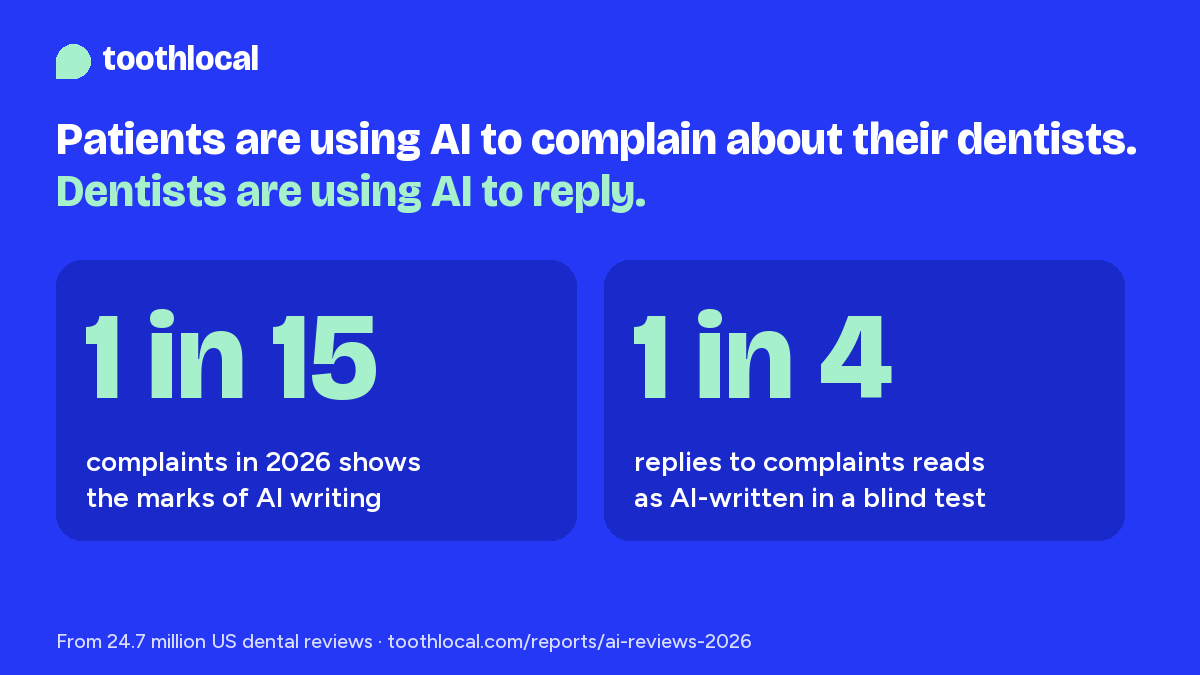
Patients are using AI to complain about their dentists. Dentists are using AI to reply.
We read 24.7 million reviews of 164,946 US dental practices. For two years after ChatGPT arrived, almost nothing changed. Then, in 2025, AI turned up on both sides of the argument.
one- and two-star reviews in 2026 shows the marks of AI writing. That's 12 times the 2023 rate.
practice replies to those complaints reads as AI-written in a blind test. In 2021 it was 1 in 120.
AI-generated review statistics, 2026
In 2026, 1 in 15 one- and two-star reviews of US dental practices shows signs of AI writing (6.8%), up from 0.57% in 2023: 12 times higher.
About 1 in 4 dental practice replies to complaints reads as AI-written in a blind test of recent replies (28 of 120), against 1 of 120 replies from 2021.
Complaints where both the patient's review and the practice's reply carry AI-writing markers rose from 36 in all of 2023 to 2,303 from January to September 2026.
15,497 US dental practices used an em dash, a common sign of AI text, in a reply to a review in 2026, up from 1,265 in 2023.
Without counting em dashes, stock AI phrases in dental complaints rose 16-fold, from 0.2% of complaints in 2023 to 3.3% in 2026.
Five-star dental reviews with AI-writing markers rose from 0.22% in 2023 to 1.75% in 2025, about 1 in 57.
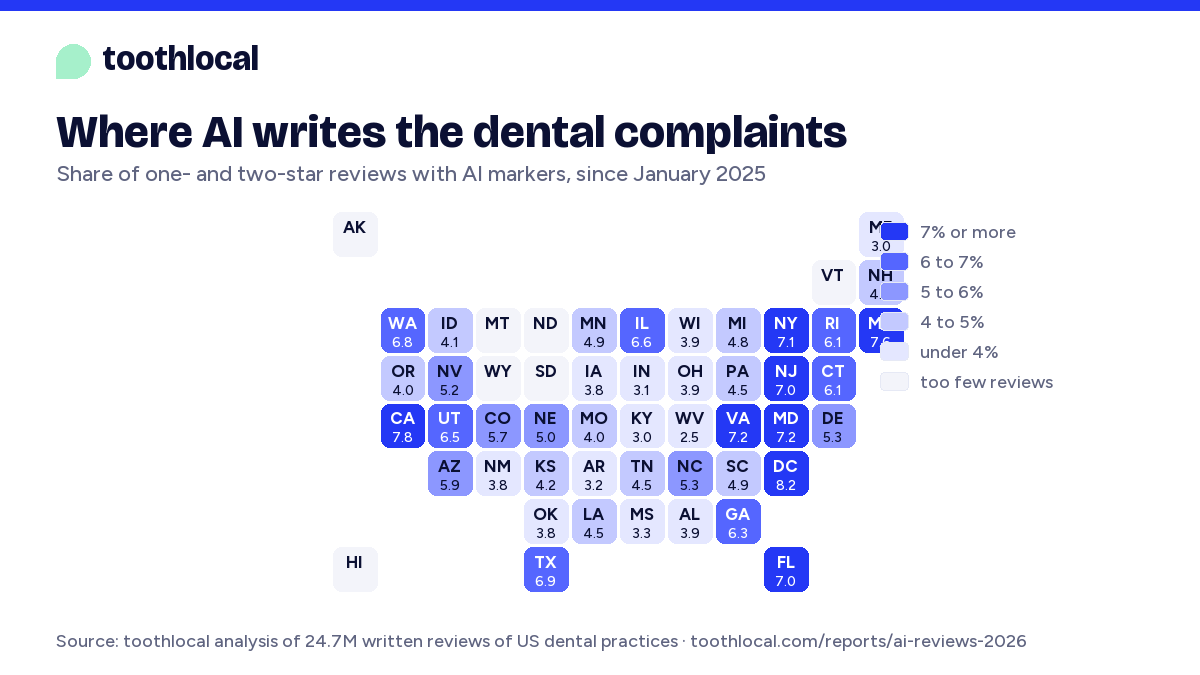
Washington DC has the highest share of AI-marked dental complaints (8.2% since January 2025) and West Virginia the lowest (2.5%).
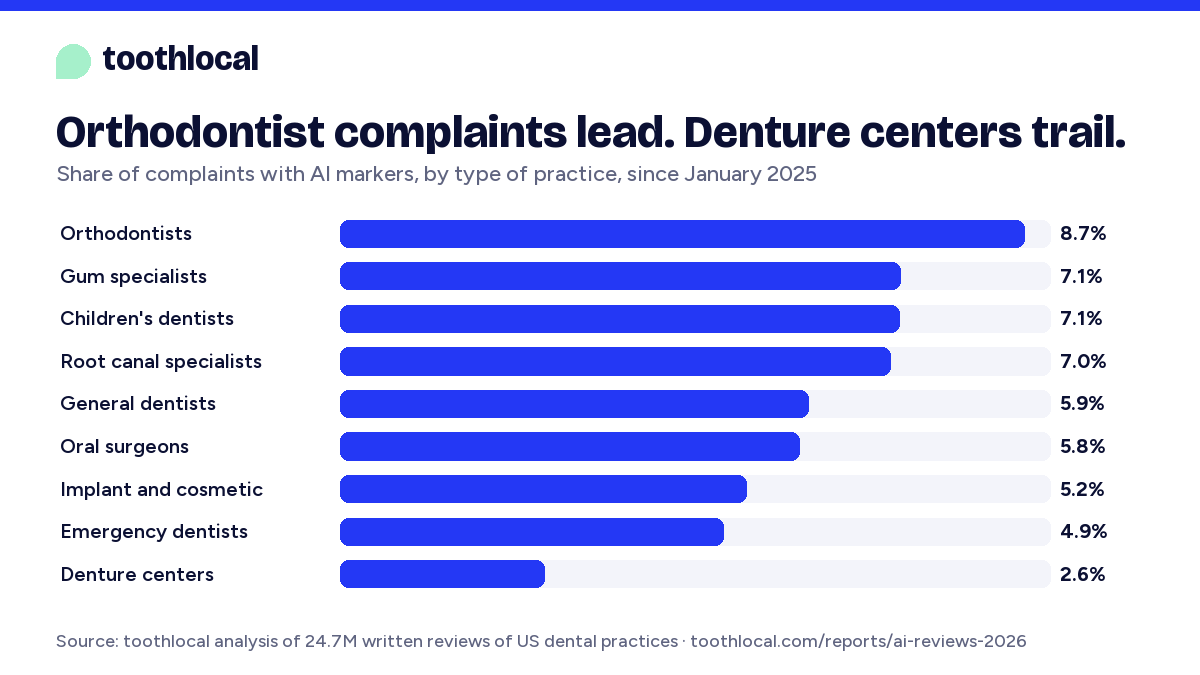
Complaints about orthodontists are the most likely to show signs of AI writing (8.7%); complaints about denture centers the least (2.6%).
AI-marked dental complaints average 1,331 characters, more than twice the 599 of other complaints.
Source: toothlocal AI Review Index, October 2026, from 24.7 million reviews of 164,946 US dental practices, January 2021 to 20 September 2026. Free to quote with a link to this page. How each figure is measured: Method and How sure are we?
Two quiet years after ChatGPT. Then 2025 happened.
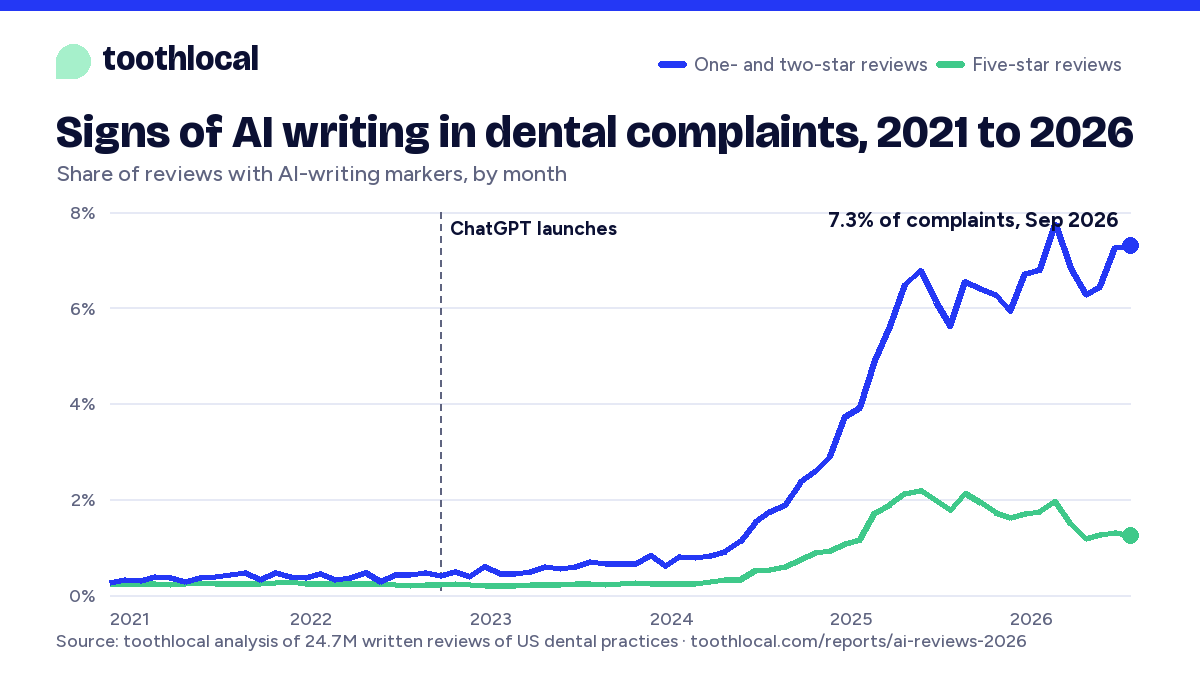
ChatGPT launched in November 2022 and dental reviews barely noticed. The share of complaints with AI markers crept from 0.4% in 2021 to 1.3% in 2024. In 2025 it quadrupled, and it is still climbing: 7.3% in September 2026. Five-star reviews moved too, just less: from about 1 in 400 before 2024 to 1 in 60 in 2025.
Move across the chart, or tap it, to read any month. Tap a key to show or hide a line.
Monthly share of written reviews with at least one AI-writing marker, January 2021 to 20 September 2026.
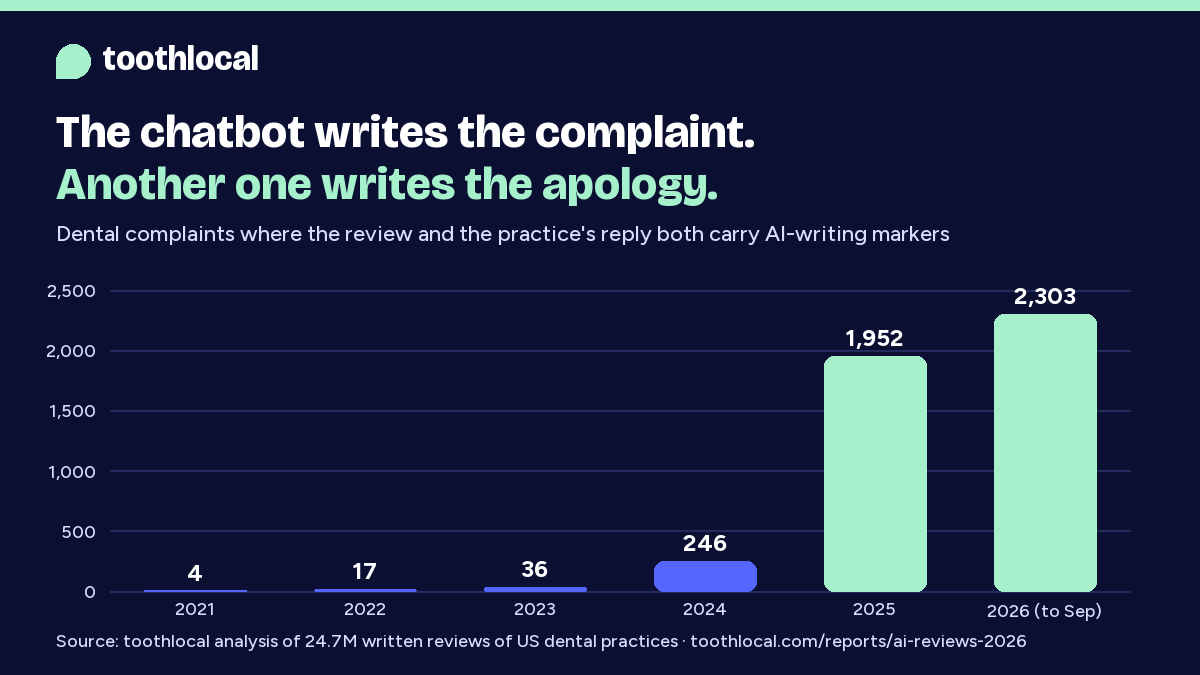
The chatbot writes the complaint. Another one writes the apology.
Picture the exchange. A patient asks a chatbot to turn a bad visit into a review. The practice pastes that review into a chatbot of its own and posts the reply it gets back. Neither side typed the words.
We can count how often both halves carry AI markers. In all of 2023 we found 36 of these exchanges. In 2025 there were 1,952. In 2026, with more than three months still to go, there are already 2,303, at 2,047 different practices.
Point at a year, or tap it, for the numbers.
One- and two-star reviews where the review and the practice's reply both carry an AI-writing marker. 2026 runs to 20 September. Markers miss a lot of AI text and catch some human writing; see How sure are we?
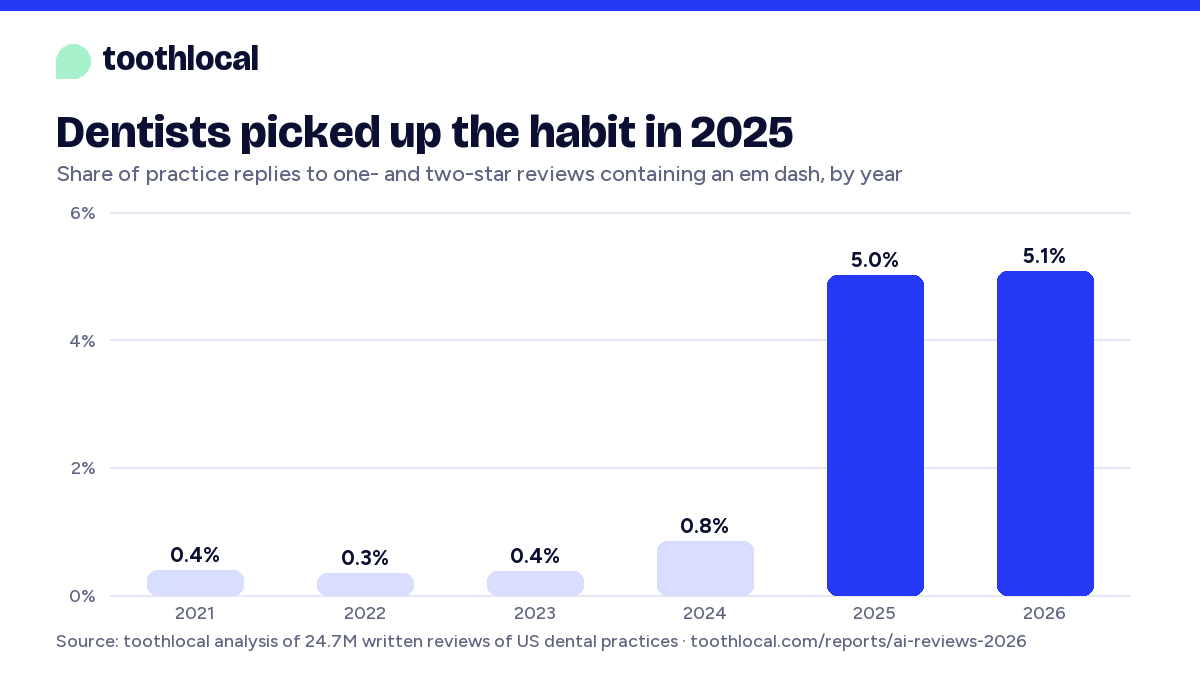
Dentists picked up the habit in 2025
Until 2024, about 1 in 270 practice replies to complaints contained an em dash, the long dash chatbots are fond of. In 2025 it jumped to 1 in 20, and it has stayed there. This isn't a handful of big chains with one template: 15,497 different practices used an em dash in a reply this year, up from 1,265 in 2023. Independent practices do it more than chains.
Point at a year, or tap it, for the numbers.
Chart: share of replies to one- and two-star reviews containing an em dash, by year of the review. The blind test is described under How sure are we?
What AI sounds like on both sides of the counter
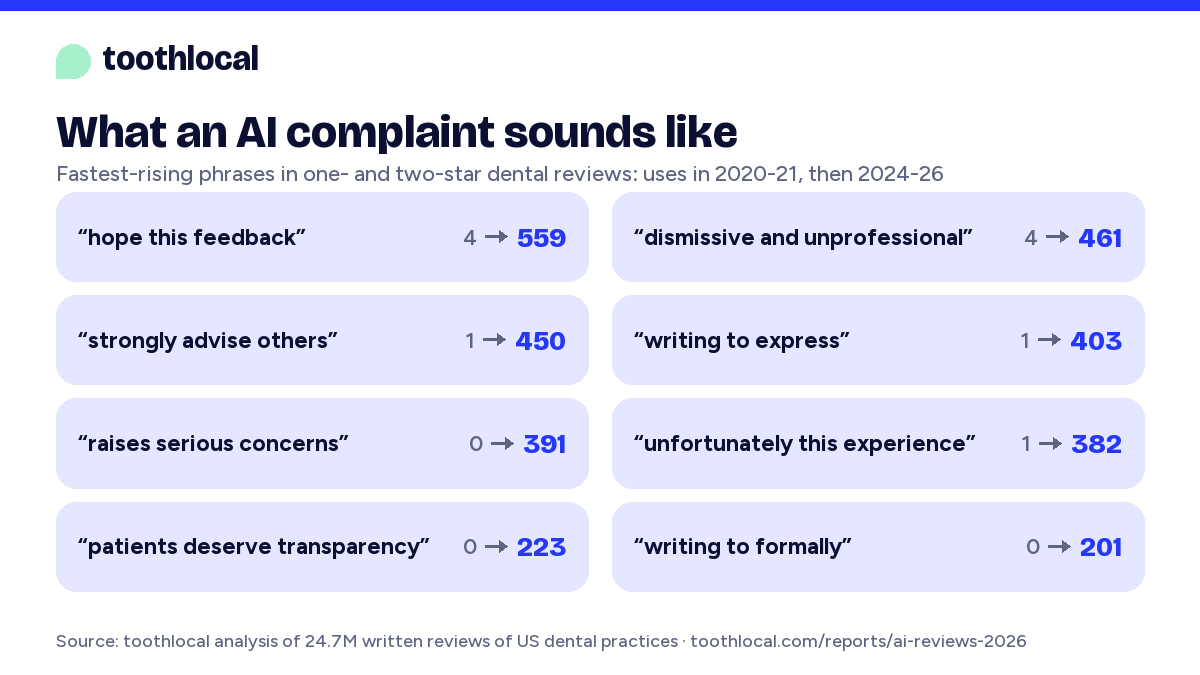
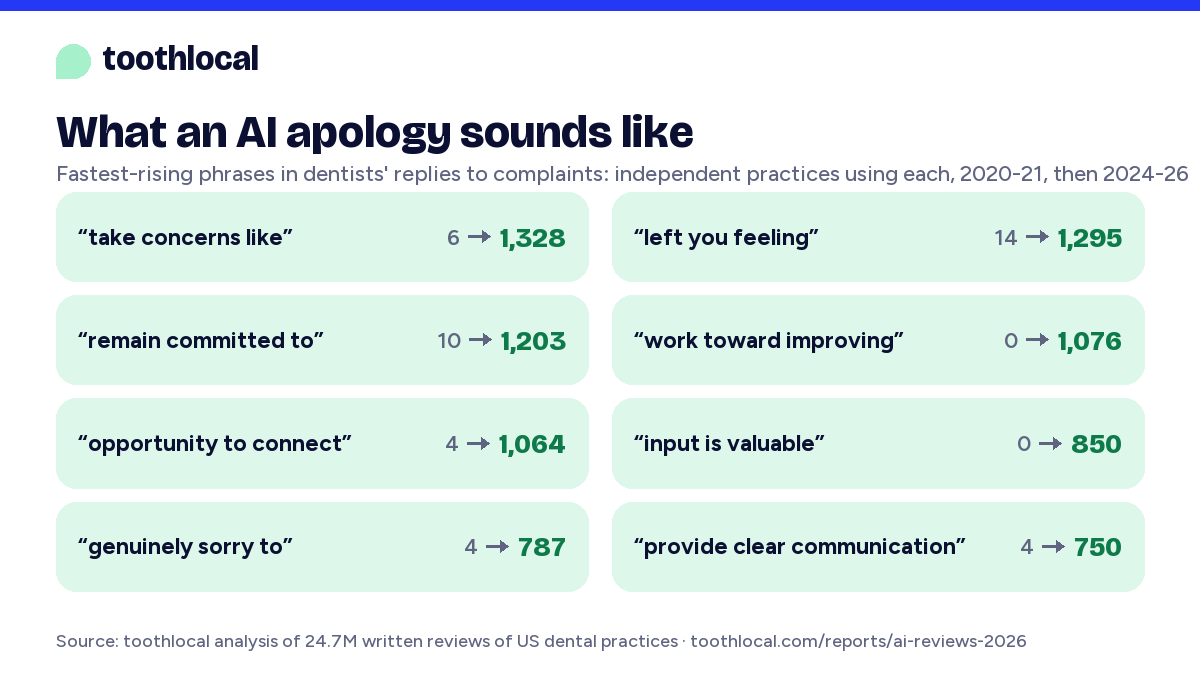
We didn't start with a list of AI words. We counted every three-word phrase in 1.2 million complaints, and in the practices' replies to them, and ranked them by how fast they grew. The winners are phrases almost nobody used before 2023.
The complaint
hope this feedback
dismissive and unprofessional
strongly advise others
writing to express
raises serious concerns
unfortunately this experience
patients deserve transparency
writing to formally
Uses in one- and two-star reviews, 2020 to 2021 against January 2024 to September 2026.
The apology
take concerns like
left you feeling
remain committed to
work toward improving
opportunity to connect
input is valuable
genuinely sorry to
provide clear communication
Independent practices using the phrase in a reply to a complaint, 2020 to 2021 against 2024 to 2026. We counted practices, not replies, and left chains out, so one company's template can't top the list.
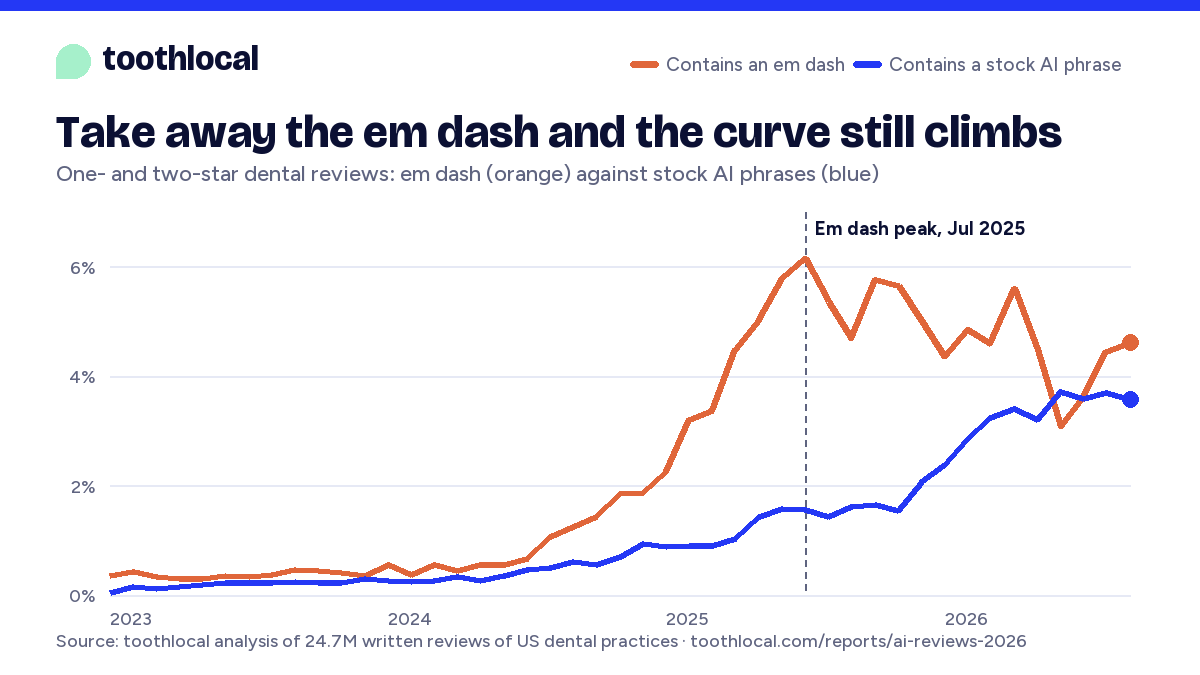
Take away the em dash and the curve still climbs
The em dash is the best-known giveaway of AI text, so it's fair to ask whether it drives the whole trend. It doesn't. In complaints the dash peaked in July 2025, when 6.2% carried one, and it has not been that high since. The stock phrases, counted with no help from the dash, kept rising: 0.2% of complaints in 2023, 3.3% in 2026. That's 16 times. AI-assisted reviews are getting harder to spot, not rarer.
Move across the chart, or tap it, to read any month. Tap a key to show or hide a line.
Polished isn't the same as fake
A complaint written with a chatbot's help can still describe a real visit. Plenty of people have something true to say and want it to sound calm, or want it in better English than they can manage when they're angry. What changes is how much the wording tells you. Smooth, formal prose used to mean a careful writer. Now it can mean anyone.
So read for the things a chatbot can't make up on its own: dates, names, amounts, what happened next. A review with those is worth weighing however it was written. One without them tells you little either way.
Review sites are seeing the same shift. Yelp said its systems filtered out nearly half a million suspected AI-generated reviews in 2025. Yelp's report
For patients
Weigh reviews by their details, not their tone. Several plain reviews that agree on specifics beat one eloquent one.
For practices
An angry patient can tell when a reply was generated. Answer the person, in your own words, and say what you'll do.
For review sites
The em dash test is already failing as writers and tools drop it. Detection that leans on one tell will keep losing ground.
The coasts type with AI. Appalachia mostly doesn't.
Washington DC leads at 8.2% of complaints, ahead of California, Massachusetts, Maryland and Virginia. West Virginia, Maine and Kentucky sit lowest, between 2.5% and 3%.
Tap a state for its numbers, or a color band to pick out its states.
One- and two-star reviews since January 2025. Gray states had fewer than 800 complaints.
Orthodontist complaints lead. Denture centers trail.
Complaints about orthodontists are the most AI-marked of any kind of practice, at 8.7%, followed by gum specialists and children's dentists. Denture centers sit lowest, at 2.6%. We haven't measured who writes these reviews, so we won't guess why.
Since January 2025. A chain is a group of practices sharing one owner's website.
AI complaints run twice as long
An AI-marked complaint averages 1,331 characters, about 230 words. An unmarked one averages 599. On five-star reviews the gap is wider still.
Average length of reviews posted since January 2025.
We tested the markers against a blind read
Markers are a blunt tool. Some people type em dashes themselves, and plenty of AI text has none of our phrases. So we drew random samples and gave them to a separate AI model to judge, one at a time, with the dates removed and the order shuffled. Nobody on our side picked the samples.
| Judged AI-written | Complaints | Replies to complaints |
|---|---|---|
| From 2021, before ChatGPT | 0 of 150 | 1 of 120 |
| From July 2025 to September 2026 | 14 of 1509%, likely range 6 to 15% | 28 of 12023%, likely range 17 to 32% |
| Recent, with AI markers | 84 of 15056%, plus 22% unsure | 41 of 10041%, plus 28% unsure |
| Recent, without AI markers | 10 of 1507% | 20 of 10020% |
What it adds up to: about 1 in 11 recent complaints and about 1 in 4 recent replies read as AI-written. The old samples show the reader isn't seeing AI everywhere: it flagged 1 of 270 reviews and replies from 2021.
For complaints the markers hold up. Only 0.4% of complaints from 2021 carried one, so false alarms are rare, but the markers catch only about 4 in 10 of the complaints the reader judged AI-written. That makes the index a floor. For replies the markers work less well, which is why our reply headline comes from the blind read, not the markers.
The reader is software, not a panel of people, and judging AI text is hard for anyone. Treat the exact figures as estimates. The direction isn't in doubt: every measure we tried, markers and blind reads alike, moves the same way at the same time.
Three stories in this data
AI is writing both sides of customer complaints
Patients use chatbots to complain and practices use them to reply. Exchanges with AI markers on both sides went from 36 in all of 2023 to 2,303 by 20 September 2026.
Can you trust online reviews when choosing a dentist?
About 1 in 11 recent dental complaints reads as AI-written. Polished isn't fake, but it says less about the writer. What to read for instead.
Your state's rank for AI-written dental complaints
43 states and DC, ranked. Pick a state for its figures, a ready-made paragraph and its own chart.
Headlines that fit the data
- Patients Are Using AI to Complain About Dentists. Dentists Are Using AI to Reply.
- 1 in 15 Angry Dental Reviews Now Shows Signs of AI Writing
- A Chatbot Writes the Complaint. Another Writes the Apology.
- AI-Marked Dental Complaints Rose 12-Fold in Three Years
- About 1 in 4 Dentist Replies to Complaints Now Reads as AI-Written
- The Em Dash Is Fading From AI Reviews. The AI Isn't.
- Complaints About Orthodontists Are the Most Likely to Show Signs of AI
- Washington DC Leads the Country in AI-Marked Dental Complaints
Post it
Cite
Charts and data are free to use with a credit and a link to this page. Every chart is a ready-made image with the source on it.
Charts and cards
Embed a chart
Data
- Monthly index, 2021 to 2026 complaints and five-star reviews
- By state complaints and replies since January 2025
- By practice type since January 2025
- Practice replies and both-sides exchanges by year
- Annual index all markers, phrases only, em dash only
- Blind-read results complaints and replies
- Rising phrases in complaints 2020 to 2021 against 2024 to 2026
- Rising phrases in replies independent practices
Press questions: use the contact form and choose “Press or partnership”.
How we measured it
- The reviews
- 24.7 million written reviews of 164,946 US dental practices on public business listings, June 2007 to 20 September 2026, with the practices' public replies. The trend uses January 2021 onward.
- AI markers in reviews
- A review is AI-marked if it contains an em dash or one of 53 phrases that rose from near zero in 2020 to 2021. We found those phrases by ranking every three-word phrase in one- and two-star reviews by growth, not by guessing.
- AI markers in replies
- A reply is AI-marked if it contains an em dash or one of 30 phrases found the same way in replies to complaints, counted by independent practices so chain templates couldn't set the list. Legal and privacy wording was left out.
- The blind reads
- Random samples (for replies, one per practice), dates hidden, order shuffled, judged by a separate AI model told that many people write long or formal reviews themselves and that an old stock template is not AI. Ranges are 95% intervals.
- Why the index is a floor
- AI text without these markers is not counted. People who type em dashes themselves are, which is why we checked with the blind reads.
- Practice types and chains
- Practice type comes from each listing's main category. A chain is a set of practices sharing one owner's website, after removing marketing platforms, health systems and listings that point to unrelated sites.
- More
- How toothlocal reads reviews in general: How we know. Something wrong? Tell us.
Find a dentist on what patients actually say
toothlocal reads every review, each practice's own website and the public license records, so you can choose on facts, not ads.
Find a dentist near youThere is not a single em dash in this report. We checked.